

Bit2 on EVM: A Milestone Towards Bit2 on Bitcoin
Bit2 on EVM: A Milestone Towards Bit2 on Bitcoin
The long-term vision of Bit2 is clear: a scalable, peer-to-peer payment system with programmable privacy, secured directly by Bitcoin. Deploying Bit2 natively on Bitcoin would maximize neutrality, censorship resistance, and alignment with the Bitcoin ecosystem. It would position Bit2 as a true Bitcoin-native financial layer for both humans and autonomous agents.
However, building directly on Bitcoin from day one is not necessarily the optimal path to adoption.
Bit2 is designed for a future where millions of autonomous agents continuously exchange value for compute, bandwidth, storage, APIs, energy, and digital services. Reaching this scale requires not only security and decentralization, but also rapid iteration, high throughput, low latency, and inexpensive experimentation. For these reasons, deploying Bit2 first on an EVM-compatible Bitcoin layer such as Rootstock is the fastest path to bringing the Bit2 vision to Bitcoin at scale. When deployed directly on Bitcoin, Bit2 can theoretically sustain around 1,600 confidential transactions per second without batching, due to Bitcoin block-space constraints. Higher throughput—potentially tens of thousands of transactions per second—requires aggressive batching strategies where multiple outputs share the same Bit2 transaction.
In contrast, deploying Bit2 on high-throughput Bitcoin L2s such as Rootstock, Liquid Network or Citrea dramatically increases scalability. Without batching, Bit2 can already reach approximately 40,000 payments per second, and with batching the throughput approaches millions of payments per second.
This difference matters enormously for agentic commerce.
Machine economies generate continuous streams of low-value transactions:
- AI agents paying for APIs,
- machines buying compute time,
- IoT devices purchasing bandwidth,
- autonomous systems coordinating resources in real time.
These systems require massive concurrency. An architecture optimized only for ultimate decentralization, while sacrificing throughput and latency, may fail to provide a usable foundation for large-scale machine economies.
Faster Commitments Improve Pre-Confirmations
Bit2 relies on timestamp commitments anchored on-chain. On Bitcoin, timestamp service providers must issue pre-commitments: signed promises that a future Bitcoin block will contain the required commitment.
To make these promises economically credible, timestamp services must post security bonds that can be slashed if commitments are not fulfilled. The longer the expected confirmation delay, the larger the bond must be, because more promises remain simultaneously outstanding.
This creates an important economic difference between deployment environments.
On Citrea, commitments can appear on-chain in roughly three seconds. As a result:
- security bonds can remain very small,
- users can simply wait a few seconds to independently verify inclusion,
- and pre-confirmation risk becomes negligible.
However, Citrea’s bridge currently depends on a security council with upgrade authority, which introduces governance trust assumptions that are not fully aligned with Bitcoin’s decentralization ethos.
Rootstock offers approximately 25-second confirmations with some variance due to its Proof-of-Work nature. While slower than Citrea, it is still dramatically faster than Bitcoin for this purpose.
Bitcoin itself provides the strongest settlement guarantees, but its slower block cadence makes pre-confirmation systems more capital-intensive and operationally complex.
Advancing Bitcoin
into the
Agentic
Era
Bit2 is the economic layer for autonomous agents
Markets are operating continuously at scale, with agents emerging as independent economic
actors. This transformation requires infrastructure designed for autonomy — neutral, global, deterministic,
and enforceable by design.
Bit2 provides the infrastructure for sovereign agents to transact trustlessly on Bitcoin.
Bit2 Is Naturally Compatible with EVM Chains
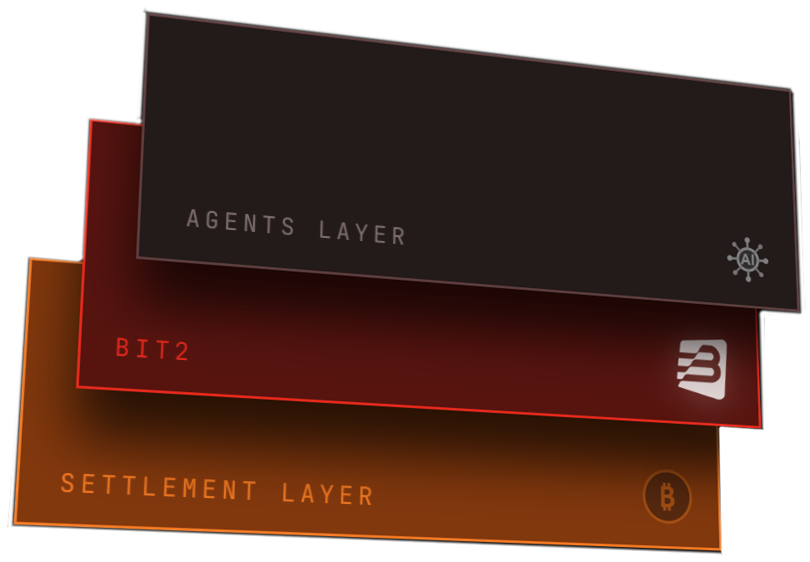
Bit2 adapts naturally to EVM deployment because its architecture already treats the underlying blockchain primarily as a publication and timestamping layer.
Most Bit2 validation occurs client-side using cryptographic proofs. As a result, Bitcoin and EVM chains provide largely equivalent services from the perspective of the protocol:
- ordered publication,
- timestamping,
- and immutable commitments.
The core Bit2 design therefore changes very little when moving from Bitcoin to an EVM chain.
Soon we will publish a technical paper describing the EVM adaptation in detail.
EVM Deployment Reduces Technical Complexity
Deploying Bit2 on Bitcoin requires additional zero-knowledge proofs related to the Bitcoin UTXO set. These proofs are necessary because Bitcoin does not expose persistent contract storage that can be queried efficiently by applications.
EVM systems simplify this significantly.
Smart contracts can maintain persistent storage directly on-chain, and contract state can later be verified using standard state proofs. This removes an important source of protocol complexity and substantially simplifies implementation.
The bridge components themselves are also relatively straightforward. Peg-ins and peg-outs between Bit2 and the hosting EVM chain can be implemented cleanly using standard smart-contract mechanisms.
This simplicity matters: it reduces implementation risk, accelerates development, shortens audit cycles and allows the protocol to evolve faster.
Rootstock Provides a Strategic Deployment Environment
We are particularly confident about deploying Bit2 on Rootstock.
Fairgate Labs participated in the design and development of the new Rootstock bridge, Union, which is based on BitVMX technology co-developed by Fairgate Labs and RootstockLabs. Union is designed to become one of the most trust-minimized Bitcoin bridges with EVM execution.
While Fairgate possesses the expertise required to build entirely new BitVMX-based bridges, leveraging an existing bridge infrastructure that we already trust significantly reduces time-to-market.
This is strategically important.
The most valuable feedback does not come from simulations—it comes from real users, real AI agents, and real economic activity. Deploying Bit2 quickly on an EVM chain allows us to gather operational data, observe adversarial conditions, refine usability, and evolve the protocol before a fully Bitcoin-native deployment.
In this sense, Bit2 on Rootstock is not a compromise. It is an acceleration strategy.
Lower Costs Create Better Economic Conditions
Bit2 consumes approximately 4 bytes of L1 space per confidential transaction.
Because Rootstock block-space costs are roughly an order of magnitude lower than Bitcoin’s, Bit2 transactions deployed on Rootstock become dramatically cheaper for both humans and autonomous agents.
This changes what becomes economically possible. Lower transaction costs are not merely an optimization—they fundamentally expand the design space of decentralized commerce.
Final Words
The ultimate destination for Bit2 may be Bitcoin itself. But building scalable financial infrastructure requires balancing ideals with execution realities.
Deploying Bit2 first on EVM-compatible Bitcoin layers allows the protocol to:
- scale earlier,
- iterate faster,
- reduce technical complexity,
- lower costs,
- and gather real-world feedback from both human users and autonomous agents.
At the same time, this path remains fully aligned with the long-term Bitcoin vision. Bit2’s architecture was designed from the beginning to preserve neutrality, minimize trust, and rely primarily on cryptographic verification rather than privileged intermediaries.
Bit2 on EVM is therefore not a departure from Bitcoin.
It is a milestone toward bringing scalable, confidential, peer-to-peer payments to Bitcoin itself—and ultimately to the machine economies that will depend on them.