

Faster than Lightning: Payment Channels on Top of Bit2
Introduction
Agentic payment systems demand two properties that are often in tension: scalability and instant responsiveness. Bit2 excels at scalable, reliable, and low-cost payments, but certain use cases—especially nanopayments between tightly coupled machines—benefit from even faster interaction models. Payment channels remain the most efficient primitive for these ultra-low-latency scenarios. By combining Bit2 with payment channels, we can achieve both: global scalability with millisecond-range settlement.
Payment Channels Still Have an Edge
Bit2 outperforms the Lightning Network across most metrics relevant to agentic payments. However, payment channels still dominate in one dimension: confirmation latency.
A payment over a unidirectional payment channel requires only a signature from the sender, which the receiver stores. No routing, no coordination, no third-party interaction. Two machines can exchange value instantly, even across the globe, with minimal overhead.
This model is ideal for nanopayments, such as:
- gaming interactions
- streaming payments
- access to shared infrastructure (Wi-Fi, compute, appliances)
- retrieval of sensor data
Bit2 Payment Channels: Ultra-Low L1 Cost
We have extended Bit2 to support payment channels directly on top of it. These channels are extremely efficient: opening or cooperatively closing a channel requires only 4 bytes of L1 data, equivalent to a standard Bit2 transaction.
This data can be encoded in:
- an OP_RETURN output (~15 weight units), or
- a Taproot annex (~4 weight units)
In contrast, the Lightning Network requires a full Bitcoin transaction (~1000 weight units) to open or close a channel. While Lightning amortizes this cost across many off-chain payments (commonly estimated at ~100:1), a Bit2-based Lightning Network (Bit2-LN) reduces the L1 footprint of channel management by approximately two orders of magnitude.
In practice, this does not translate directly into 100× cheaper payments, because Lightning’s dominant cost is not L1 bandwidth but locked capital. However, for nanopayments—where channel balances remain small—this efficiency becomes highly relevant.
Improving Bit2 Usability with Channels
Bit2 relies on timestamping service providers (TSSPs) to anchor user commitments efficiently. These services will likely charge users, for example via prepaid “stamp” bundles (e.g., 100 stamps for $1).
However, prepaid credits introduce friction:
- they are non-transferable
- unused balances may be lost when switching providers
- refunds are not guaranteed
Payment channels solve this cleanly.
By opening a channel with a TSSP, users can:
- pay per timestamp request
- avoid prepaid lock-in
- recover unused funds at any time via unilateral close
This removes third-party credit risk and turns the interaction into a pure pay-per-use model, which is much better aligned with agentic systems.
Advancing Bitcoin
into the
Agentic
Era
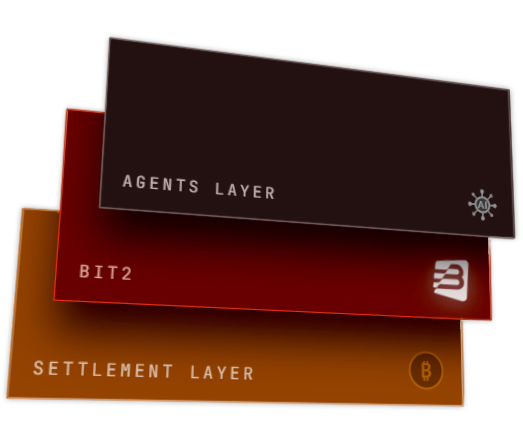
Bit2 is the economic layer for autonomous agents
Markets are operating continuously at scale, with agents emerging as independent economic
actors. This transformation requires infrastructure designed for autonomy — neutral, global, deterministic,
and enforceable by design.
Bit2 provides the infrastructure for sovereign agents to transact trustlessly on Bitcoin.
Building a Payment Channel Network on Bit2
Beyond direct channels, Bit2 supports the construction of Hash Time-Locked Contract (HTLC) networks similar to the Lightning Network. This enables:
- private multi-hop routing
- instant payments without relying on bonded pre-confirmations
- compatibility with existing Lightning-style protocols
In other words, Bit2 can host a Lightning-like network, or an entirely new PCN, with significantly improved base-layer efficiency.
Why Bit2-LN Outperforms Bitcoin Lightning
Even though payment channels inherently require locked capital, a Bit2-based Lightning Network offers several advantages over native Bitcoin Lightning:
- Cheap rebalancing
Channel top-ups and withdrawals are inexpensive, removing the need for complex routing-based rebalancing. - Dynamic capital allocation
On platforms like Rootstock, funds can be moved in and out of channels to access yield-generating DeFi opportunities, potentially in an automated way. - Faster iteration on channel designs Advanced constructions such as Eltoo can be deployed without requiring Bitcoin soft forks.
These properties make Bit2-LN significantly more flexible and capital-efficient in practice.
Conclusion
Bit2 does not replace payment channels—it subsumes and enhances them.
By providing a highly scalable, low-cost settlement layer, Bit2 removes the traditional bottlenecks of payment channel networks, while preserving their unmatched speed for local interactions. The result is a hybrid architecture where:
- Bit2 handles global, high-throughput payments
- payment channels handle ultra-fast, localized interactions
This combination is particularly powerful for agentic economies, where machines require both deterministic settlement and instant responsiveness.
Bit2 lays the foundation for this future—not just as a payment network, but as a platform on which the next generation of programmable, high-performance payment systems can be built.